Nido launches the digest
You tell it what you hold and in the morning you get an email limited to that…
What is this?
One email a week with curated news from your portfolio.
No irrelevant news, no endless lists.
In under a minute, in your inbox
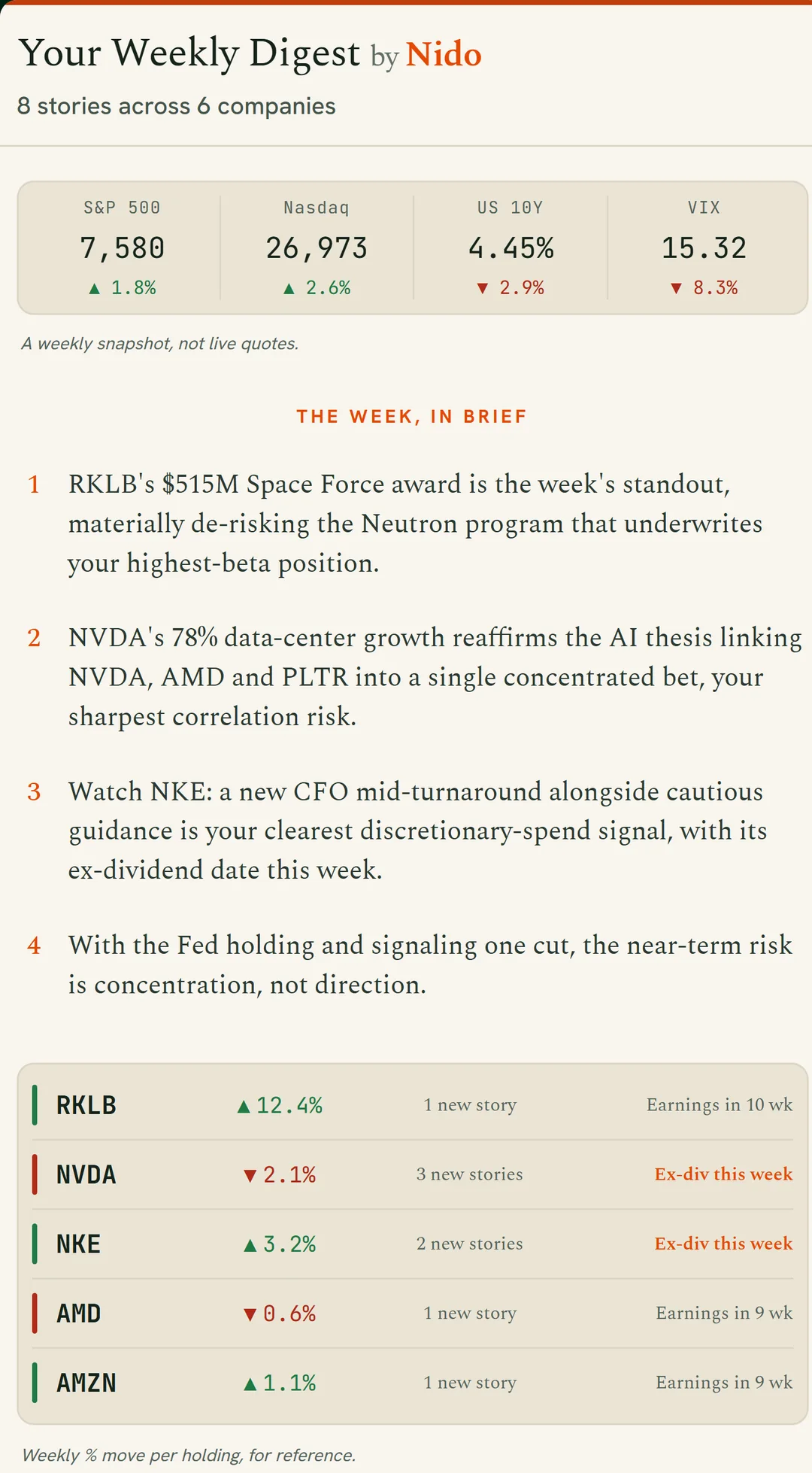
This is what lands on Tuesday
Rocket Lab wins a $515M Space Force contract
Your angle: a government anchor customer de-risks the program your position is effectively a bet on.
The sources we read for you
The five principles: why we built this
Blindness aside, noise has a fairly concrete shape. An enormous amount of information about markets is published every day, and the portion that actually affects a given portfolio is small, but it arrives mixed in with everything else, in no order and through ten different channels. The investor who wants to keep up ends up processing a hundred things to keep three, and repeats that work every day without it giving them any edge, because it is the same work everyone else does.
The digest starts there. You tell it what you hold and in the morning you get an email limited to that: the news on your tickers, the price moves that broke from the usual, and the calendar for the coming days, record dates, coupon payments, amortizations, maturities, earnings. With the CCL rate, interest rates and the month's inflation, which in an Argentine portfolio are part of the return and not a piece of color.
Before that there is a filter. Most of what gets published about a company is rehash, a headline built for the click, or a story with nothing new in it. That does not come through.
And what does come through arrives explained. Nobody follows ten industries deeply enough to read a material event and know what it means. If an aerospace company you own wins a multi-year contract, the news says it won, and what you need to know is how big it is against annual revenue, when the money starts coming in, what margin that kind of contract usually carries and whether it commits capacity that was already sold. That translation is half the work.
What it does not do is tell you what to buy. You built the portfolio and the reasons are yours. The digest makes sure that what confirms them or breaks them arrives on time, and in a form you can understand.
It is built for the investor who ended up between those two paths: the one who built a portfolio on their own judgment, has a reason for every position, and works at something else. Not for the one who trades all day, nor for the one who has already decided not to look.
Updates
You tell it what you hold and in the morning you get an email limited to that…
Blindness aside, noise has a fairly concrete shape. An enormous amount of information about markets is published every day, and the portion that actually affects a given portfolio is small, but it arrives mixed in with everything else, in no order and through ten different channels. The investor who wants to keep up ends up processing a hundred things to keep three, and repeats that work every day without it giving them any edge, because it is the same work everyone else does.
The digest starts there. You tell it what you hold and in the morning you get an email limited to that: the news on your tickers, the price moves that broke from the usual, and the calendar for the coming days, record dates, coupon payments, amortizations, maturities, earnings. With the CCL rate, interest rates and the month's inflation, which in an Argentine portfolio are part of the return and not a piece of color.
Before that there is a filter. Most of what gets published about a company is rehash, a headline built for the click, or a story with nothing new in it. That does not come through.
And what does come through arrives explained. Nobody follows ten industries deeply enough to read a material event and know what it means. If an aerospace company you own wins a multi-year contract, the news says it won, and what you need to know is how big it is against annual revenue, when the money starts coming in, what margin that kind of contract usually carries and whether it commits capacity that was already sold. That translation is half the work.
What it does not do is tell you what to buy. You built the portfolio and the reasons are yours. The digest makes sure that what confirms them or breaks them arrives on time, and in a form you can understand.
It is built for the investor who ended up between those two paths: the one who built a portfolio on their own judgment, has a reason for every position, and works at something else. Not for the one who trades all day, nor for the one who has already decided not to look.
Starting your digest, or do you already have an account?